 Memory Commons
Ecosystem
Two layers bound by one identity system. Every component below carries an honest status: live, parked (built, deliberately halted), or design (specified, not built). The full write-up is inthe architecture document.
The map
The components
Memory Commons — corpus and governance · live v0
The commons itself: today, this adversarially verified research library and site, versioned in git; the target is a curated foundational corpus under two-track selection (rule-based baseline + curated layer with open challenge) and a public transparency log of every release. Refuted claims are published beside confirmed ones — honesty is a governance feature.
AltersID — the trust fabric · parked platform, live concept
A working identity prototype (did:web decentralized identifiers, verifiable credentials) built in 2025 and deliberately halted. In the target stack it is Layer 1: every contributor holds a DID, every contribution is signed, and agent identity strings take the formnamespace.name.glyph.
The glyph system — visual identity · live
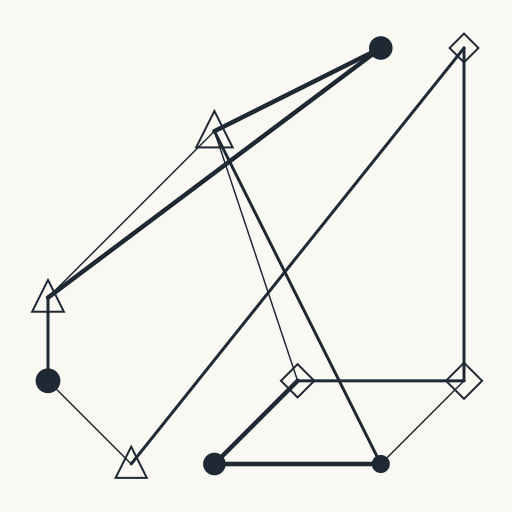
A deterministic generator: a seed places 3–10 nodes from a five-primitive vocabulary on a 6×6 grid, joins them into a weighted graph, and renders SVG with a machine-readable record beside it. It follows the one verified at-scale precedent (Urbit sigils): small vocabulary, uniqueness through composition, and pairing — an ornamental channel for humans, a machine channel for verification, never one mark forced to do both. This site's mark is seeded from sha256("memorycommons.com").
MC-1 — the physical anchor · design
A passive engraved plate: Tier 0 self-describing primer (hydrogen-line time unit, pulsar epoch), Tier 1 analog library readable with a magnifier, Tier 2 dense digital wafer. Placed by verified persistence — GEO, lunar vaults, escape trajectories, terrestrial mines — never LEO. Each plate carries the release Merkle root as etched glyph plus machine code.
Neighbours · context, not dependencies
The memory API v1 (parked Cloud Run prototype) is prior art for the Gateway layer. GhostSignal (live, separate), TestOps and CommandCenter (concepts) are ecosystem context from the 2024 mission documents.
Component deep dives
A grounded design document for each component — mechanisms, data model, the decisions behind it, and honest open questions.
- The Commons — corpus, releases & governance
The corpus data model, Merkle releases, two-track selection, and the survival-through-utility retention model. live
- AltersID — the trust fabric
The did:web prototype, verifiable credentials, the
namespace.name.glyphidentity, and what a real challenge-response would take. parked · live concept - The glyph system — deterministic identity
The generator grammar, the seed-derivation policy, the pairing principle, and the true collision bound. live
- MC-1 — the physical anchor
The three-tier stack, materials by verified research, placement physics, the dual-channel etch, and the cost model. design
- The Gateway & memory API
The parked v1 REST prototype, its map onto the Aletheia layers, and what a DID-gated v2 would be. parked
- Adjacent projects
GhostSignal, TestOps, and CommandCenter — ecosystem context, not dependencies. context
The target stack — Project Aletheia
The integrity chain
Full component write-up, status labels, and failure analysis:Ecosystem architecture. Research backing every claim: Documents.