 Memory Commons
How it works
Ecosystem shows what the pieces are; this page shows how each mechanism actually works — with the real commands and the real first release as the worked example.
Cutting a release
A release is a snapshot of the corpus that anyone can verify forever. The items are listed in a plain text file, sorted by path. Each file is hashed (SHA-256 of raw bytes), the hashes form the leaves of a Merkle tree — each node is the hash of its two children's hex digests concatenated, unpaired nodes promote unchanged — and the root becomes the release's identity. The construction is stated inside every manifest, so verification never depends on external documentation surviving.
Release 0000 was cut and verified with:
python3 corpus/tools/release.py --cut --release 0000 --date 2026-07-06 --items corpus/releases/release-0000.items.txtpython3 corpus/tools/release.py --verify corpus/releases/release-0000.json
Root: cda2045f630c20e3d7518ca6a09533121b06e1384651756cf069b124a5613afd. Change one byte of one item and the root changes; hold any two copies of the corpus and they either agree exactly or provably differ.
Generating a glyph
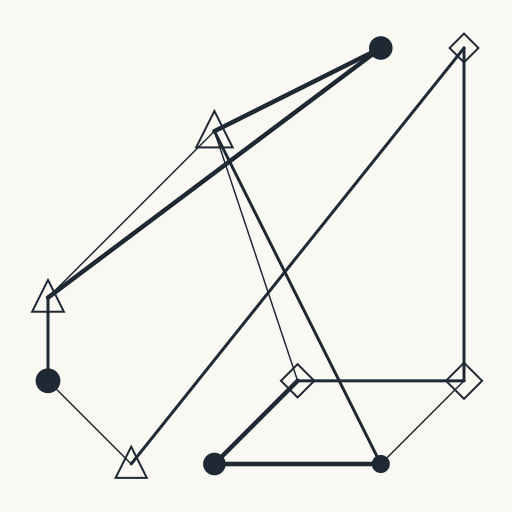
A glyph is a deterministic visual identity: a 32-bit seed drives a fixed generator that places 3–10 nodes from a five-primitive vocabulary (dot, ring, square, diamond, triangle) on a 6×6 grid and joins them into a weighted graph, rendered to SVG with a machine-readable JSON record beside it. Same seed, same glyph, forever — roughly 5.8×10³⁵ distinct outputs. The design follows the verified lessons of prior identity-mark systems: a small vocabulary with uniqueness through composition, and pairing — the ornament is for human recognition, the hash beside it is for machines; no single mark is forced to do both jobs.
project · seed = sha256("memorycommons.com")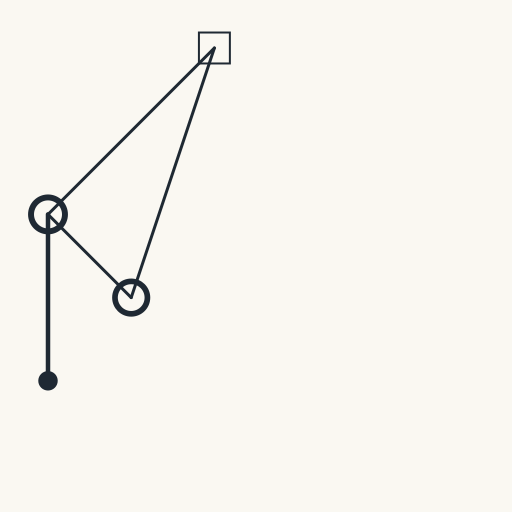
release 0000 · seed = first 4 bytes of the Merkle root
Identities get glyphs from their DID hash; releases get glyphs from their Merkle root. The mark etched on a physical artifact is therefore not decoration — it is the checksum, in a form a human can remember and recognize.
The MC-1 artifact
The physical anchor (status: design) is a passive engraved plate, ~100×100×3 mm, under 300 g, no power, no electronics, no interface to its host — which is what makes it cheap to qualify and easy for any satellite or lander to carry. Three tiers, each the key to the next:
Tier 0 — the primer (etched, visible at low or no magnification): a time-and-frequency definition from the neutral-hydrogen line, the launch epoch encoded as a pulsar map, a binary counting tutorial, and the catalog — where the other artifacts and the living archive are. The techniques are flown and peer-reviewed, not speculative.
Tier 1 — the analog library (nickel microetching, readable with a magnifier): the foundational set — mathematics, physical constants, the genetic code, languages presented Rosetta-style, images of human life, music as notation and waveform, the senses rendered as the chemistry that produces them, and the project's charter. Nothing in this tier requires any technology to decode beyond optics.
Tier 2 — the dense digital layer (fused-silica or equivalent wafer): the full corpus release, with its decoding procedure taught pictorially in Tier 1. The release's Merkle root is etched on the jacket as glyph plus machine-readable code, so the plate authenticates any surviving digital copy — and any two plates corroborate each other.
Placement follows the verified persistence ladder onAttempts: GEO hosted payloads, lunar surface and lava-tube vaults, escape trajectories, terrestrial mines — never LEO. Redundancy over monuments: many cheap plates, shipped whenever something is already going.
Integrity across decades
Today the chain is: content versioned in git, releases hashed and published at a price-cap-protected domain, deployment reproducible from a public manifest, and the repository mirrored off-machine. Planned, pending the current research round: contributor signatures over DIDs, provenance manifests in the C2PA style, long-term signature validation so proofs survive key and algorithm rotation, and post-quantum signatures for anything meant to be checked decades out. The design principle that outlasts all of it: cryptography only has to survive from one release to the next — when every key is lost, the etched root is still the root of trust.
Architecture overview: Ecosystem · verified research behind every claim: Documents · current release: 0000.