 Memory Commons
Ecosystem Architecture
Memory Commons reference library · July 2026. The system as designed and as it actually exists today — every component carries an honest status label: live, parked (built, deliberately halted), or design (specified, not built).
The shape of the system
Memory Commons is two layers bound by one identity system.
The living layer is a digital commons: a curated corpus of foundational human knowledge with public governance, published continuously. The anchor layer is physical: write-once artifacts carrying corpus releases into environments that outlive institutions — orbits, vaults, the Moon. The identity layer binds them: every contribution is signed, every release is hashed, and the hash is rendered as a glyph that humans recognize and machines verify.
The design bet behind all of it: prior deep-time projects addressed strangers who must stumble onto an artifact — effectively zero probability. This system addresses successors who inherit the catalog. The living layer is the catalog; the anchors are its disaster-recovery tier and trust root.
Components
Memory Commons — the corpus and its governance
Status: live (v0). Today: this reference library (adversarially verified research with published sources, votes, and refuted claims) plus the public site, versioned in git. Target: a curated foundational corpus (knowledge, culture, values, the chemistry of the senses) under two-track selection — a rule-based inclusion baseline plus a curated layer with open challenge — and a public transparency log of every release. Governance standards (C2PA provenance, long-term signatures, post-quantum) are an open research round.
AltersID — the trust fabric
Status: parked platform, live concept. A working prototype exists (FastAPI: did:web decentralized identifiers, verifiable credentials, agent_name@alters.id identities) and is deliberately halted. In the target architecture it is Layer 1: every contributor — human or agent — holds a DID; contributions carry verifiable signatures; agent identity strings take the form namespace.name.glyph. Known risk to resolve before revival: alters.id rides Indonesia’s ccTLD, an unassessed sovereignty exposure.
The glyph system — visual identity
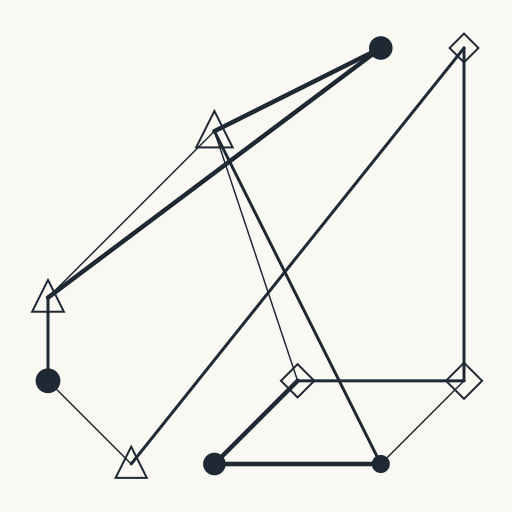
Status: live. A deterministic generator (project 3rdlayer-lights, Feb 2026): a seed drives placement of 3–10 nodes from a 5-primitive vocabulary on a 6×6 grid, joined into a weighted graph, rendered to SVG with a machine-readable JSON record beside it (~5.8×10³⁵ output space). Design follows the one verified at-scale precedent (Urbit sigils): small hand-designed vocabulary, uniqueness through composition, and pairing — an ornamental channel for humans plus a machine channel (hash/QR), never one mark forced to do both. This site’s mark is glyph mc-0001, seeded from sha256("memorycommons.com"). In the full system: DID hash → agent glyph; release Merkle root → release glyph.
MC-1 — the physical anchor artifact
Status: design. A passive plate (~100×100×3 mm, <300 g, no power, no host interface): Tier 0 etched primer (hydrogen-line time unit, pulsar epoch map, binary tutorial, catalog of other artifacts), Tier 1 analog library (nickel Nanofiche, ~magnifier-readable), Tier 2 dense digital wafer (fused silica), in a deliberately regular engraved jacket. Placement by verified persistence: GEO hosted payloads (century-verified stability, deep-time plausible), lunar surface and lava-tube vaults (~290 K, radiation-shielded), escape trajectories, terrestrial vaults. LEO excluded (regulatory 5-year cap). Each plate carries the release Merkle root — etched glyph plus machine channel — so any recovered artifact authenticates any surviving copy.
Memory API v1 — the parked prototype
Status: parked. A deployed GCS-backed Cloud Run service (REST /memory/{agent_id}, API-key auth) from the 2025 iteration. Kept as prior art for the Gateway layer; not part of the current build.
Neighbouring projects
GhostSignal (live, separate): signal detection; shares the personal-infrastructure estate, not the trust chain. TestOps (concept, killed): independent safety/audit controller. CommandCenter (concept): orchestration. These are ecosystem context from the 2024 mission docs, not dependencies.
The target stack — Project Aletheia
The 2025 “Project Aletheia” design remains the reference architecture for the living layer, mapped to present reality:
| Layer | Target design | Today (v0) |
|---|---|---|
| 1 · Trust Fabric | DIDs + verifiable credentials, sovereign keys, client-side encryption | contributor git identity; AltersID parked |
| 2 · Agora | lightweight ledger: registry, data index, policy, economic accounts | git history as transparency log |
| 3 · Library | encrypted, chunked, replicated storage across host nodes | git repo + published library + findings JSONs |
| 4 · Gateway | gRPC/HTTPS APIs (register, store, retrieve, query) | static site; v1 REST prototype parked |
The 2025 economic design (“survival through utility”: memory persists because it is used, contributed to, and valued — with human stewards) is retained as the retention model for the corpus; its token mechanics are explicitly deferred.
The integrity chain
- A contributor (human or agent, DID-signed) submits or curates content with provenance metadata.
- A corpus release is cut: a Merkle tree over every item; the root is the release identity.
- The root seeds the release glyph; root + glyph + full catalog (including artifact locations) are published on the living layer.
- Anchors are written: the release goes to artifacts with the root etched as glyph (human channel) and hash/QR (machine channel).
- Verification runs both directions, indefinitely: any artifact authenticates any digital copy; any two artifacts corroborate each other; cryptography only has to survive between releases — the etching is the root of trust when all keys are lost.
Failure honesty
What breaks this system: content-selection capture (mitigated by two-track selection and published refutations, unproven at scale); institutional death before enough anchors exist (KEO’s fate — mitigated by shipping small artifacts early and often); vendor-claim media longevity (mitigated by claim-labelling and medium diversity); and the unfunded gap between a website and a first flown artifact (open — funding models are a research round, with Memory of Mankind’s €60–350 retail model the one verified precedent).